Voice of Customer
AI tags feedback, code flags spikes
- 14xJump in packaging complaints, from 1 mention in July to 14 in August
- 120Feedback items from 3 sources put into one format
- 111 of 120Items that fit the 8 preset themes
Portfolio project, realistic test data. See all results
A direct-to-consumer (DTC) brand’s customer feedback is scattered across product reviews, post-purchase surveys and support tickets, each in its own format and with its own wording. Reading through it by hand is slow and always behind: by the time someone notices a pattern across dozens of reviews, the underlying issue (a packaging defect, a shipping problem) has often already affected weeks of orders.
Voice of Customer
What I Built
A four-stage process turns scattered feedback into a ranked, actionable monthly digest. Every item, whichever of the three sources it came from, moves through the same four stages:

Here’s a walkthrough of the system in action:
- Puts three sources into one format
Reviews, post-purchase survey responses and support tickets, each exported in a different layout, are mapped into a single Raw Feedback table.
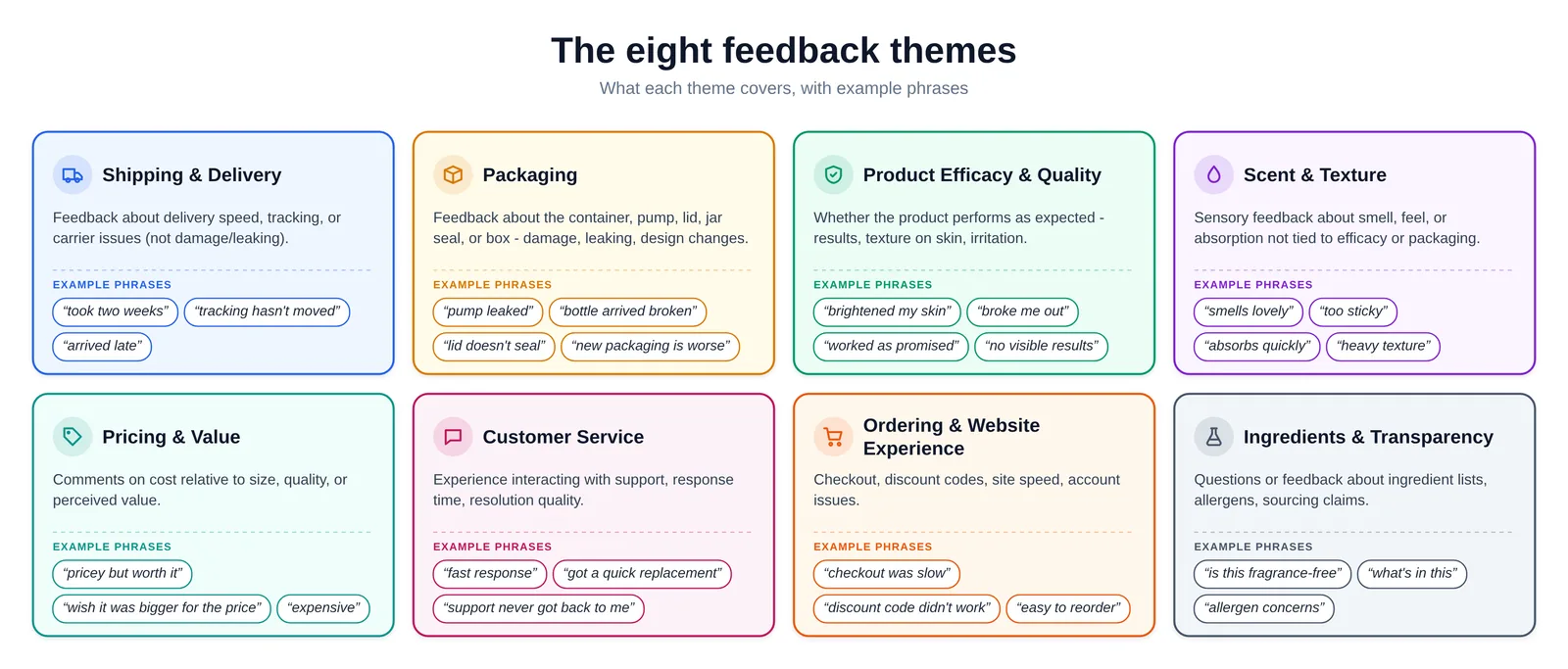
- Sorts feedback into eight set themes, with room for new ones
Each item is tagged for sentiment (positive or negative), severity and one of eight preset themes. When something doesn’t fit well, the AI flags it as a new theme and proposes a name for it instead of forcing a bad fit.
- Counts each theme every month and flags unusual jumps
Each theme’s monthly count is compared with a baseline built from its own history. Once there is enough history, the alert level is its average plus two standard deviations (a statistical measure of how much it normally varies), with a minimum count so a theme can’t trigger an alert on tiny numbers.
- Builds and emails a monthly digest automatically
Top pain points with AI-drafted recommended actions, top praise themes, emerging themes and spike alerts, assembled into one email and sent automatically on the first of the month.
Voice of Customer
Engineering Highlights
Select a heading to read the detail. Select it again to close it.
Rather than forcing every piece of feedback into one of eight preset categories, the AI is told to flag when nothing fits and propose its own category name. That turns a silent mistake (feedback filed under the wrong theme) into a visible queue someone can review.
Each theme is compared against a baseline rebuilt from its own history every month. Once a theme has at least three earlier months, the alert level is its average plus two standard deviations (a measure of how much it normally varies). With less history it falls back to a simple rule: alert at 1.5 times the usual level. A minimum count of five means a theme can’t trigger an alert on tiny numbers.
The system flagged a genuine 14-fold jump in Packaging complaints (1 mention in July to 14 in August) automatically, in the same run it happened in. Only two earlier months existed, so it used the simple 1.5-times rule, and it attached supporting customer quotes. No one had to review the data by hand to notice it.
Voice of Customer
Results
This is a portfolio project on a fictional business: the results below are illustrative of how the system behaves on realistic test data, not measurements from live usage.
What each claim rests on
Each row matches a claim from What I Built or Engineering Highlights with the test behind it. Tested on 120 feedback items from three sources. Rows run from the strongest evidence to the weakest.
A fixed set of themes, plus room for new ones
Of 120 items, 111 fit the eight themes and 9 were flagged as new themes and sent for review.
Tested on 120 itemsThe spike it caught
Packaging went from 1 mention in July to 14 in August and was flagged in the run that included August, with supporting customer quotes attached.
Shown in one testA fully automated monthly digest
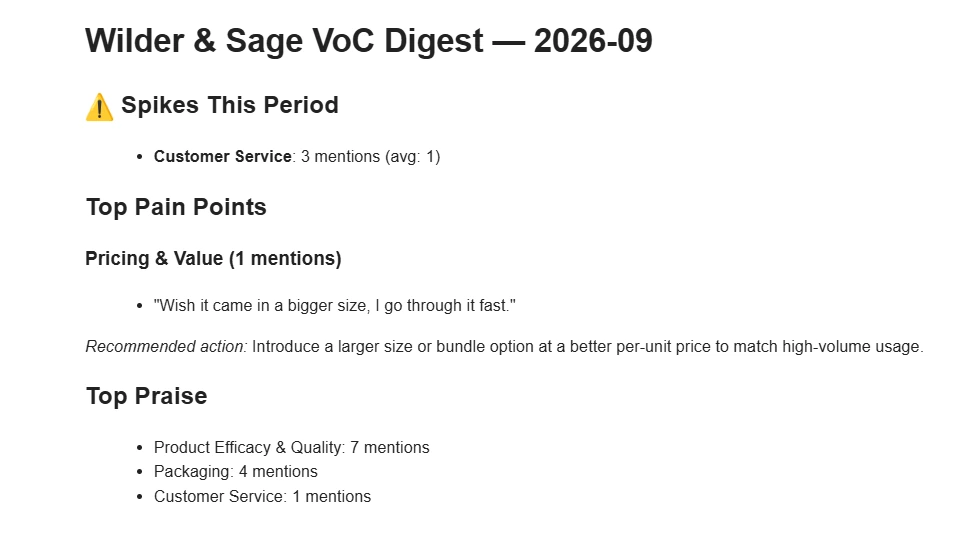
A sample digest for September 2026 is shown below: a spike alert, a top pain point with a recommended action and the top praise themes.
Shown in one testSpike alerts that adapt to each theme’s normal ups and downs
The Packaging spike was caught by the simple 1.5-times rule, because only two earlier months existed. The adaptive baseline (average plus two standard deviations) and the minimum count of five were not exercised by this example.
Designed, not tested
Limits: One spike in 120 items shows detection working once, not how often it fires or misses.
The numbers
A fully automated monthly digest arrives by email with ranked pain points, AI-drafted recommended actions, top praise themes and emerging issues, with no manual compiling. Every ranked theme, every flagged spike and every quote is one click from the original feedback it came from.
How this helps your business
What you get from a system like this.
Problems spotted sooner
Spikes are caught the same period they occur, not weeks later when someone happens to notice a pattern across dozens of individual reviews.
Nothing forced into the wrong bucket
Items that don’t fit the eight preset themes are flagged and given a proposed name instead of being filed under the wrong one.
One consistent format
Reviews, surveys and tickets, each exported in a different layout, all end up in one table that can be compared side by side.
Fewer false alarms
Alert levels based on each theme’s own history, plus a minimum count of five, are designed to keep small random swings from triggering false alarms.
Ready to act on
The monthly digest comes with AI-drafted recommended actions attached to each ranked pain point, not just raw counts.
No manual compiling
The digest is assembled and emailed automatically on the first of the month.
Full traceability
Every ranked theme, every flagged spike and every quote is one click from the original feedback record it came from.
Early warning on emerging issues
New themes appear in a queue for review instead of waiting for someone to spot a new pattern by hand.
Let’s find what your process is letting slip.
Book a free 30-minute call. We’ll look at one process that’s costing you time, leads or money and where it breaks down today.